What EIFS is
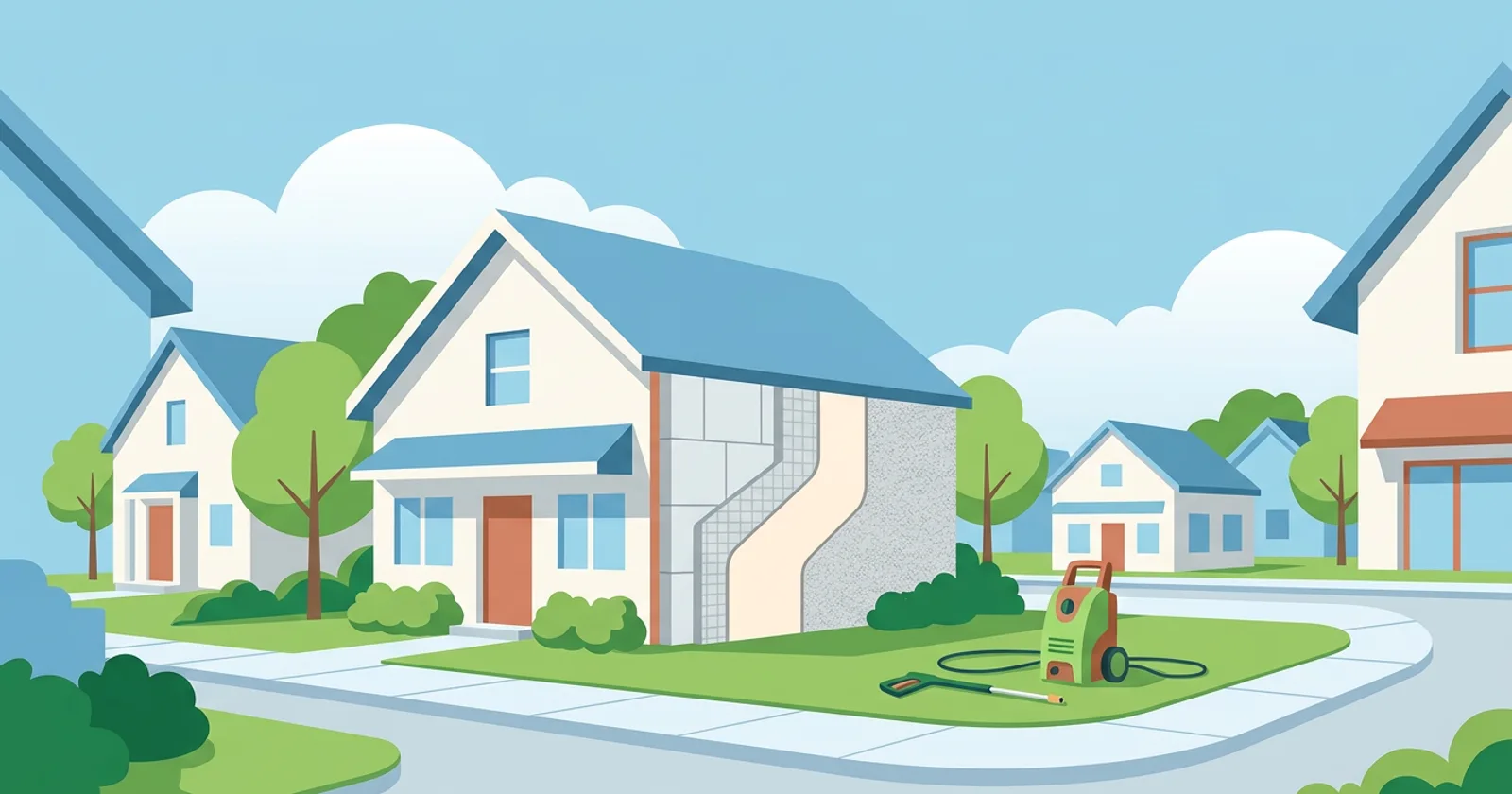
The EIFS industry’s trade association defines EIFS as three layers. There’s an insulation board attached to the wall, a reinforced base coat, and a textured finish coat. A home inspectors’ association puts it more plainly. It’s foam board and fiberglass mesh, covered with a polymer-based coating textured to look like historic stucco. It’s often used on wood-framed houses.
Traditional stucco is a plaster applied wet over the wall. One EIFS maker’s cleaning spec treats it as a solid surface. From the curb, the two can look the same. Under a pressure washer, they don’t behave the same.
Homeowners mix them up. On a pressure washing forum, one homeowner planned to wash a two-story house with a 3,000 psi electric washer. Most of the house was stucco, but some sections were what they called “high density foam.” In another thread, a homeowner asked what the foam coming off their stucco was. Replies guessed at efflorescence and asked for wider photos. A close-up rarely settles it.
How to tell EIFS from stucco
| Check | EIFS (synthetic stucco) | Hard-coat stucco |
|---|---|---|
| Knock with a knuckle | Hollow tone | Solid |
| Press with a thumb | Flexes under pressure | Solid substrate (Sto) |
| Look at a chip or damaged spot | Foam board | Plaster, no foam |
| Layers | Foam board, mesh, base coat, finish | Plaster applied wet |
| Makers’ pressure cap for washing | 500 psi (Sto, Sika, Dryvit) | 2,500 to 3,000 psi for coatings on stucco (Sto) |
| Foam trim or shapes on the wall | 500 psi (Sto) | 500 psi for the foam parts (Sto) |
A commercial inspectors’ group describes the knock test the same way. EIFS typically feels hollow, flexes under pressure, and gives a distinctive hollow tone. Don’t drill or cut to check. If you can’t tell, have an inspector confirm it.
Many houses are both. Foam bands, window trim and decorative shapes can sit on a real stucco wall. One EIFS maker’s cleaning spec allows 2,500 to 3,000 psi for coatings on solid stucco. The same spec caps foam trim at 500 psi, even when it’s attached to stucco. That’s five to six times less pressure on the trim than on the wall around it.
What EIFS makers allow
Three EIFS makers’ cleaning guides line up closely:
- Pressure. Use no more than 500 psi. One maker says to stay around 200 to 500 psi and keep the nozzle several feet away. Another says never closer than 2 feet. A third says at least 12 inches.
- Tip. Use a wide fan tip, 30 degrees or more.
- Chemicals do the work. One maker’s bulletin says the chemicals provide the cleaning, not the water pressure. For mold and mildew, it lists 1 part bleach to 20 parts water.
- Pre-wet first. One maker calls skipping the pre-wet the number one oversight in cleaning EIFS.
- No hot water or steam. One maker says the foam board’s service temperature limit is about 165°F.
- No solvents, wire brushes or stiff bristles. Solvents can get through the finish and damage the foam. Abrasion damages the finish.
One maker also warns that frequent power washing can wear the finish early. Another says EIFS cleaning should be done by a skilled professional, using lots of water at low pressure.
In other words, a careful soft wash. Our guide to soft washing your own house covers the basic setup. A two-story EIFS house is a good case for hiring out.
Bleach matters in humid climates
Houston’s main airport averages about 52 inches of rain a year. If you live somewhere that wet, note this. One maker warns that trisodium phosphate detergent feeds mold. It says not to use that detergent without bleach in hot, humid climates. Mold has to be killed with bleach or it comes back. If a washer’s mix skips the bleach step, ask why.
What to look for after a wash
Pressure isn’t the only risk. The home inspectors’ association says water gets behind EIFS through cracks. It also gets in where EIFS meets windows, doors and the roof. The earliest EIFS were “barrier” systems. Versions with a drainage layer are the main type installed today.
After the wall dries, walk around and look for:
- Gouges or fuzzed finish where the tip got too close
- Cracked or pulled-away caulk at windows, doors and joints
- Bulges, which the inspectors’ association says can mean coatings are delaminating from the foam
- Soft or stained wood on window or door frames, a sign water may already be in the wall
Take photos before the job so you can compare. Our guide to wash damage versus damage that was already there explains how. If you see bulges or soft wood, an inspector can test moisture with a small probe. It leaves holes about 1/8 inch across.
What to tell the washer
Say “this house has EIFS” on the first call. Point out any foam trim. Then ask:
- What pressure and tip will you use on the foam sections?
- Do you pre-wet, and do you use bleach in the mix for mildew?
- Will you check the caulk and photograph problem spots first?
A washer who goes quiet at “EIFS” may not have cleaned it before. Our questions to ask a house washing company cover the rest of the call. For stucco stains from other causes, see our guide to sprinkler rust stains. Here’s how we check every claim.
Sources
Based on 11 sources · How we price
- EIFS Industry Members Association, About EIFS: eima.com/abouteifs.html
- EIFS Industry Members Association, Technical Bulletin EIMA-001, About EIFS with Drainage (2024): eima.com/uploads/1/4/6/6/146696713/eima_technical_bulletin_001-_about_eifs_with_drainage.pdf
- Sto Corp., StoTherm Repair and Maintenance Guide, Cleaning EIFS 1.01: stocorp.com/wp-content/content/Systems_TechService/reStore/Installation%20and%20Repair/IG_S707B_StoTherm_Repair_and_Maintenance_Guide_EN.pdf
- Sto Corp., reStore Cleaning guide specification RC100: stocorp.com/wp-content/content/Systems_TechService/reStore/Specifications/doc/SPEC_RC100_%20reStore_Cleaning_EN.doc
- Sika (Senergy), Technical Bulletin, Procedure for Cleaning Finish and Removing Efflorescence in EIFS and Stucco (2024): usa.sika.com/dam/dms/us01/m/us-senergy-tb-procedure-cleaning-finish.pdf
- Dryvit, Essential EIFS Maintenance and Repair Guide: dryvit.com/blog/eifs-maintenance-repair-guide
- Dryvit, DryvitCARE brochure: dryvit.com/resource/download/L-0072_DryvitCARE_Brochure.pdf
- InterNACHI, Water Damage and EIFS: nachi.org/water-damage-eifs.htm
- Certified Commercial Property Inspectors Association, Inspecting Commercial EIFS Siding: ccpia.org/inspecting-commercial-eifs-siding
- NOAA National Centers for Environmental Information, 1991–2020 annual normals, Houston Intercontinental Airport: ncei.noaa.gov/access/services/data/v1?dataset=normals-annualseasonal-1991-2020&stations=USW00012960&dataTypes=ANN-PRCP-NORMAL&format=json
- Community discussion, r/pressurewashing, foam coming off stucco (2026): reddit.com/r/pressurewashing/comments/1u51kzb