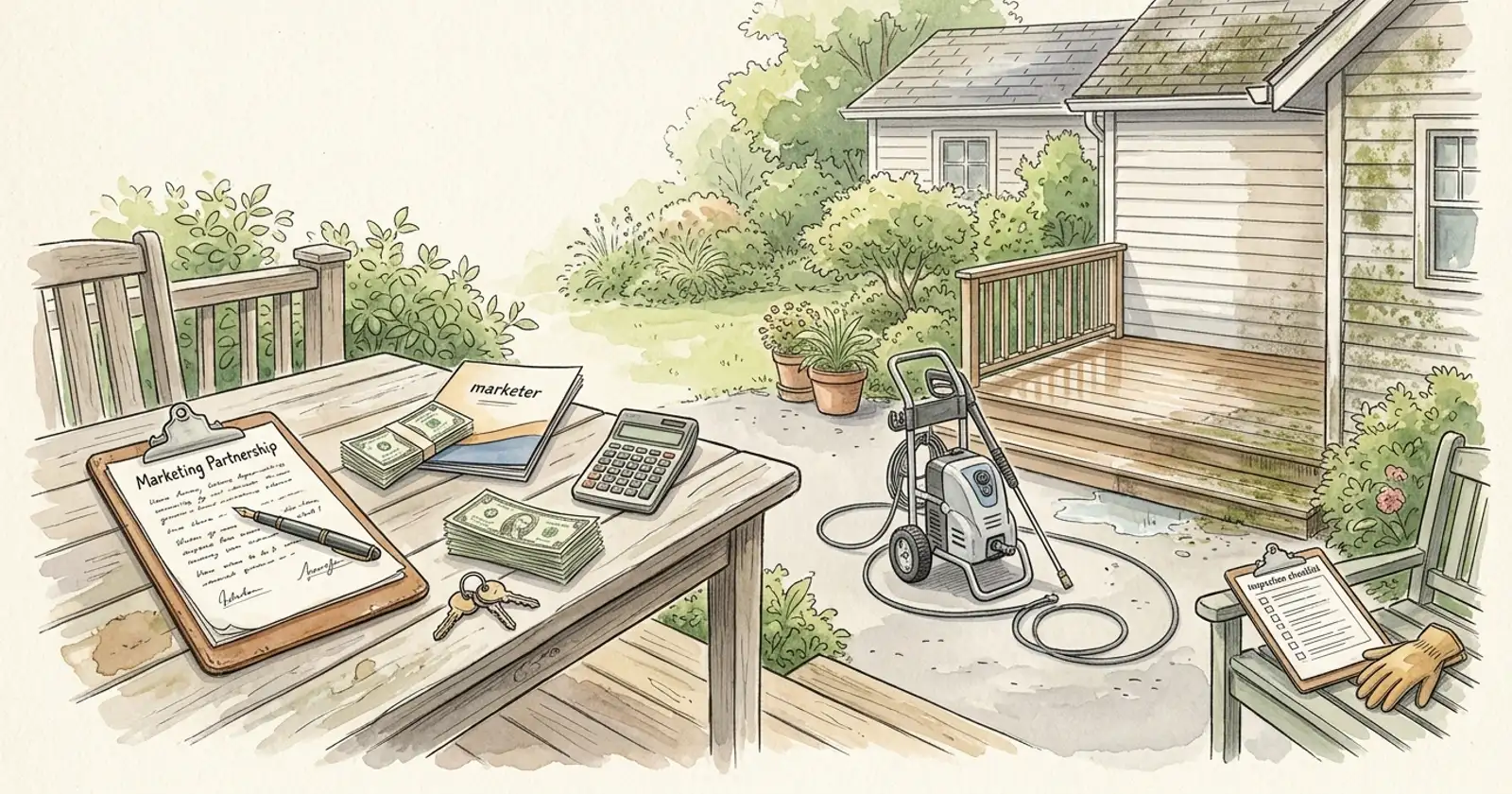
This comes up in washers’ forums. In one thread this year, an owner said “marketing guys” kept offering to take the customer side and pay his normal rate while keeping the difference. He asked whether that was normal and what to watch for. Replies split. A couple of commenters said they had done steady work this way. One said it can make sense for jobs outside your area, as long as the reseller stays out of your own service area. One pointed out that the customer belongs to the reseller, so every job through him is a dead end for repeat business and referrals.
The math: a spread vs your own cost per customer
On a $500 job, a $100 spread is 20% of what the customer pays, or 25% on top of your $400 price. One commenter in the thread said his leads averaged about $121 per new customer, so at that cost a $100 spread is the cheaper way to get a first job. Anyone who gets customers for less would come out behind.
Repeat work changes it. Our assumption: a house wash that rebooks once a year for three years.
| Arrangement | What it costs you over 3 years | What to check |
|---|---|---|
| Find the customer yourself, at $121 (one poster’s figure) | $121 once | Your real cost per booked job |
| Reseller keeps $100 on every visit | $300 | Who the customer calls next year |
| Reseller hands the customer over after one job | $100 once | Whether that’s in writing |
| Pay-per-lead or referral fee | Per lead or per job, agreed up front | Whether you pay for leads that don’t book |
The rows are our arithmetic and reading, not quotes from any company. How we research: methodology.
For what each lead channel costs, see our guide to pressure washing lead sources. Realtor referral fees work differently; see pre-listing washes and agent referral fees.
Red flags and a checklist before you say yes
- The customer never learns your name. If the reseller wants you unbranded and the customer calls them for a redo, you carry the work and the reputation risk without the relationship.
- Payment after the customer pays them. Ask when you get paid, by what method, and what happens if the customer disputes the charge. Get it in writing. For one payment trick aimed at washers, see the overpayment check scam.
- A non-solicit clause. Some agreements bar you from working for the customer directly later. Read yours, and check your agreement and local rules before you sign.
- No written scope. You should see exactly what the customer was promised. Otherwise you inherit any overpromise made to justify the markup.
- Whose name is on the contract. In some states, licensing rules turn on who contracts with the homeowner. For California, see the contractor license question for washers. Check your own state’s rules.
Insurance paperwork
Expect a partner to ask for your certificate of insurance. One large insurer’s guide says a certificate summarizes coverage, limits, policy numbers and dates. It warns against accepting a certificate that didn’t come from an insurance agent or company. It also suggests asking for a fresh one each time, because coverage can change.
If the partner wants to be named on your policy, a construction underwriter at another insurer says the certificate provides only information, not coverage. Additional insured status comes from an endorsement on the policy. Ask your agent what that endorsement covers and costs before you agree.
Sources
Based on 3 sources · How we price
- A washers’ community thread (Jan 2026), “marketing guys” offering to resell washes (not linked)
- Central Insurance blog, Adding an additional insured to a certificate of insurance: contractors and subcontractors edition (Nov 2025): blog.central-insurance.com/additional-insured-to-certificate-ofinsurance
- The Hartford, Certificate of insurance (COI): thehartford.com/business-insurance/certificate-of-insurance